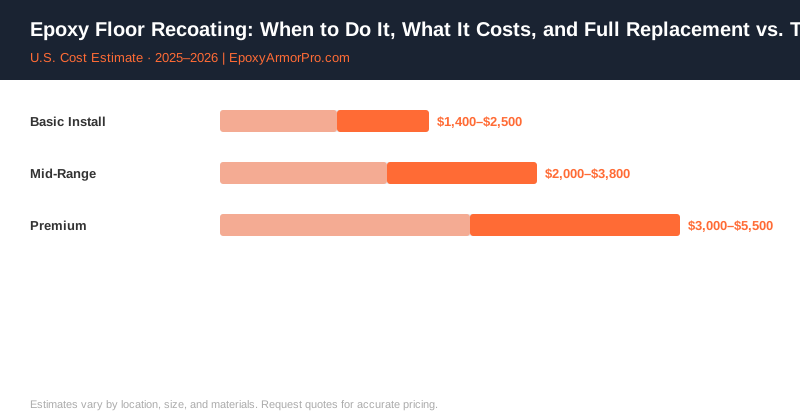
Most epoxy floors last 5–10 years before the topcoat shows real wear. At that point, you face a decision: recoat what’s there, or strip it and start over. Choose wrong and you’re spending money twice.
Here’s how to tell which situation you’re in, what each option costs, and what recoating actually requires.
Signs It’s Time to Recoat
The worn-out topcoat is usually obvious before the base coat fails. Look for:
Surface dulling or scratching — The gloss is gone in high-traffic lanes (tire tracks, walking paths). The floor looks worn and flat compared to when it was new. This is wear on the topcoat only; the base coat is likely still intact.
Loss of slip resistance — Flake texture that once provided grip feels smooth. Water on the surface feels slippery. This is the topcoat wearing away and exposing the smoother base layers.
Minor surface abrasion — Fine scratches from dragging items, foot traffic with grit underfoot. The base coat is still sound; only the top protective layer is compromised.
Color fading — Especially in UV-exposed areas. Aliphatic urethane and polyaspartic topcoats resist UV better than epoxy clears, but all eventually fade in direct sunlight.
These are all topcoat issues. If only the topcoat is worn, recoating is a viable and cost-effective option.
Signs that recoating won’t work:
Cracks in the epoxy (not hairline concrete cracks showing through, but cracks in the epoxy film itself) also indicate structural or adhesion failure that topcoat can’t fix.
Yellowing throughout — Base coat has UV-degraded all the way through. Topcoat won’t restore color or structural integrity.
Recoating vs. Full Replacement: The Decision Matrix
| Condition | Recommended Action | Cost Range (500 sq ft) |
|---|---|---|
| Dull topcoat, no peeling | Topcoat recoat only | $500–$1,500 |
| Worn topcoat + minor surface scratches | Light sand + new topcoat | $600–$1,800 |
| Delamination in isolated spots only | Spot repair + recoat if adhesion test passes | $800–$2,000 |
| Widespread peeling or delamination | Full strip and reinstall | $1,500–$3,500 |
| Failed base coat or moisture damage | Full strip and reinstall | $2,000–$4,000+ |
The 80/20 rule applies here: if 80% or more of the floor is still bonded and in good condition, recoating is usually worth considering. Below that, you’re fighting the battle section by section, and a full reinstall often makes more long-term sense.
What Proper Recoating Prep Requires
Recoating is not just rolling a new coat over the old one. Adhesion between coatings requires the same mechanical bond that the original coat needed to the concrete — just between two epoxy layers instead of epoxy and concrete.
Step 1: Deep clean — Degrease and clean the entire floor with a commercial concrete degreaser. Any oil, tire rubber, or chemical contamination on the surface will cause the new coat to fish-eye or delaminate.
Step 2: Adhesion testing — Before committing to a recoat, test whether the existing coating is sound. The cross-cut adhesion test (ASTM D3359) is the standard: score a grid pattern in the coating with a utility knife, press tape firmly to it, pull it off sharply. If the coating pulls off with the tape, adhesion is failing and full removal is needed.
Step 3: Abrasive scuff — The existing topcoat surface needs to be abraded — either by hand-sanding with 60–80 grit sandpaper, floor buffing with a scuff pad, or light diamond grinding. This creates a mechanical tooth for the new coat to grip. The surface should look uniformly dull and scratched after this step — any glossy areas are problem spots.
Step 4: Vacuum and wipe — All sanding dust removed. Tack cloth or vacuum, followed by a clean dry cloth.
Step 5: Topcoat application — New topcoat goes down by squeegee and back-roller, same as original installation. Most recoat situations call for a polyaspartic or aliphatic urethane topcoat, not a re-application of standard epoxy clear — the UV-stable formulas last longer as the exposed wear layer.
Cost Breakdown for Recoating
Professional recoating costs $1–$3 per square foot for most residential floors in good base condition. That compares to $3–$7 per square foot for full installation including prep, primer, base coat, flakes, and topcoat.
For a 500-sq-ft garage, that’s:
- Topcoat recoat only: $500–$1,500 (labor + materials)
- Full reinstallation: $1,500–$3,500
DIY recoating costs $150–$400 in materials for a 500-sq-ft garage — primarily the topcoat product and any sanding supplies. Labor is your time, typically a full day.
One caution on DIY recoating: the scuff-sanding and degreasing steps are easy to rush, and they’re exactly as critical here as surface prep is for new installations. A recoat that fails adhesion is money wasted, not money saved.
How Long Recoated Floors Last
A properly prepared recoat adds 3–7 years of service life on a floor that was otherwise sound. It won’t restore a heavily worn or UV-damaged base coat to like-new condition — the recoat follows the contours and color of what’s underneath. But it restores the protective function of the topcoat and the slip resistance of the surface.
Floors that see heavy vehicle traffic every day may need recoating every 5–7 years on a maintenance schedule even if the base coat is fine. That’s significantly cheaper per cycle than full replacement.
For context on what full epoxy flooring life expectancy looks like, see our how long does epoxy flooring last guide.
Contractor Referral Disclaimer: EpoxyArmorPro is a contractor referral and cost information service, not a licensed flooring contractor. We connect consumers with independent, licensed, and insured contractors. We do not perform any flooring work directly. Cost estimates are averages based on market data and vary by location, project size, materials, and contractor. Always verify contractor licensing and insurance before hiring. Individual quotes may differ from estimates shown.