A restaurant that fails its health inspection because of the floor doesn’t get a second chance with opening-week diners. Health department inspectors in most states cite floor condition and cleanability as one of the top five inspection violations — and that’s before you account for the slip-and-fall liability that comes with a slick commercial kitchen floor.
Restaurant kitchen epoxy isn’t a style choice. It’s a compliance and safety specification. Here’s exactly what the codes require, what the right installation looks like, and what you’ll pay.
What FDA and Health Codes Actually Require
Restaurant kitchen floors are regulated by your state and local health department, which typically adopts the FDA Food Code as its baseline. Here’s what FDA Food Code Section 6-201.11 specifies:
“Floors and floor coverings of all food areas shall be constructed of smooth, durable, nonabsorbent, easily cleanable materials.”
That rules out bare concrete (porous and not cleanable to a standard that prevents bacterial harborage) and grout lines (bacteria accumulate in grout and it can’t be sanitized reliably). Properly specified epoxy meets all four criteria when fully cured.
Your specific state and county health codes may add requirements on top of FDA baseline. Common additions:
- Minimum slip resistance specifications (COF values)
- Coved base requirements (transition between floor and wall)
- Approved material lists or specific product certifications
- Color requirements (light colors required in some jurisdictions to show soiling)
Get a copy of your local health code before selecting a product. Your contractor should be familiar with local requirements — if they aren’t, that’s a meaningful red flag.
Coefficient of Friction: The Number That Prevents Lawsuits
Slip-and-fall incidents in commercial kitchens cost the US food service industry an estimated $2 billion annually in workers’ compensation claims, according to the National Floor Safety Institute. The single most controllable factor is floor surface traction.
Coefficient of friction (COF) is measured by the BOT-3000E or pendulum test (ASTM C1028 and ASTM F2508). Here’s what the numbers mean:
| COF Value | Classification | Application |
|---|---|---|
| Below 0.42 | Hazardous | Should not be used in commercial kitchens |
| 0.42–0.49 | Marginal | Minimum for dry areas only |
| 0.50–0.59 | Acceptable | FDA Food Code minimum for kitchen areas |
| 0.60–0.79 | Good | OSHA-recommended for wet commercial floors |
| 0.80+ | Excellent | Best practice for grease-exposed kitchen areas |
The NSF recommends COF above 0.5 for food service wet areas. OSHA’s general industry standards (29 CFR 1910.22) require “safe” surfaces and cite slip-resistance as a factor. Many liability attorneys use COF 0.60 as the benchmark in slip-and-fall litigation.
For restaurant kitchens — especially areas near dishwashing stations, fryers, and prep sinks — specify COF 0.60+ wet. Achieve this with aluminum oxide or silicon carbide broadcast into the topcoat. The texture is visible and adds to the non-institutional appearance. The broadcast grit adds $0.50–$1.00 per square foot and is completely non-negotiable for a commercial kitchen application.
The Coved Base Detail: What It Is and Why Inspectors Care
Coved base is the curved transition between the floor and the wall at the bottom of every wall junction. Instead of a 90-degree corner where the floor meets the wall (which collects debris, moisture, and bacteria in a space that’s nearly impossible to clean), a coved base creates a smooth radius that can be mopped clean in a single pass.
Most health codes require coved base in food preparation and food handling areas. The specification:
- Minimum radius: typically 3/8" to 1/2"
- Height: typically 4–6 inches up the wall
- Material: must be the same cleanable material as the floor, or ceramic cove base tile set in sealed mortar
Epoxy coved base is the premium solution: the floor coating extends up the wall in a formed radius, creating a seamless, monolithic surface from floor to wall. There are no joints, no grout lines, no transition strips — nothing that bacteria can colonize.
Epoxy coved base installation adds $15–$35 per linear foot to the project cost. A typical 500 sq ft kitchen might have 100–150 linear feet of coved base perimeter — adding $1,500–$5,250 to the floor project. It’s a meaningful cost, but it’s also the detail that health inspectors specifically look for.
Full Cost Breakdown for Restaurant Kitchen Epoxy
Restaurant kitchen epoxy is more expensive per square foot than most other applications because of the compliance specifications, coved base, and commercial-grade products required.
According to the Concrete Network, commercial kitchen-grade epoxy systems average $8–$14 per square foot for the floor alone, before coved base:
| Component | Cost per Sq Ft / Linear Ft | Notes |
|---|---|---|
| Primer coat (moisture vapor barrier) | $1–$2.50/sq ft | Required in most kitchen slabs |
| Body coat (100% solids, food-safe) | $2–$4/sq ft | FDA-compliant formulation |
| Topcoat (anti-slip, aliphatic urethane) | $2–$3.50/sq ft | COF 0.60+ specification |
| Anti-slip broadcast (aluminum oxide) | +$0.50–$1/sq ft | Non-negotiable for wet areas |
| Epoxy coved base | $15–$35/linear ft | Health code requirement in most states |
| Drain detailing (per drain) | $200–$500 | Seamless transition around floor drains |
| Total floor system (300–600 sq ft) | $6–$14/sq ft | Before coved base add-on |
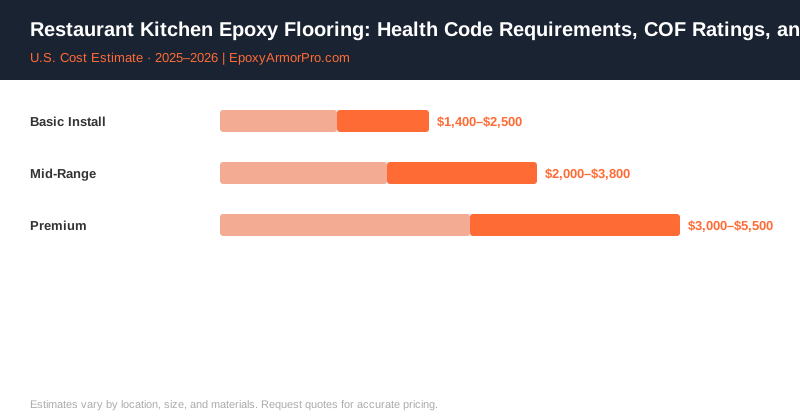
A 400 sq ft commercial kitchen with full coved base (120 linear feet) and proper three-coat system: expect $3,500–$7,500 for the floor system plus $1,800–$4,200 for coved base — total $5,300–$11,700. That’s a real project cost, not a misleading advertised starting price.
Downtime: The Business Impact
A restaurant kitchen installation means the kitchen is closed. For established restaurants, that’s the dominant cost concern.
Timeline for a properly executed restaurant kitchen install:
- Prep (grinding, crack repair, degreasing): 4–8 hours for 400 sq ft
- MVB primer and cure: 8–12 hours
- Body coat and cure: 12–16 hours
- Topcoat and cure: 12–16 hours
- Coved base application and cure: 8–12 hours (typically done concurrently with floor cure)
- Return to food service: 72 hours minimum; 5–7 days for full chemical cure
Most restaurant operators schedule this for a Monday–Wednesday closure, reopening Thursday. Alternatively, a total kitchen rebuild during planned vacation or holiday closure eliminates the revenue impact.
Fast-cure polyaspartic systems can compress the timeline to 36–48 hours. For restaurants where each day of closure represents $3,000–$15,000+ in lost revenue, the 30–40% premium for polyaspartic systems is often justified on the first project.
Maintenance: What a Properly Installed Kitchen Floor Requires
Epoxy kitchen floors are significantly easier to maintain than tile-and-grout systems, but they require the right cleaning approach to preserve the anti-slip texture and coating integrity.
- Daily: Mop with pH-neutral commercial cleaner diluted per manufacturer’s spec. Do not use full-strength bleach daily — it’s acceptable for sanitizing periodically but degrades the topcoat over time.
- Weekly: Degreasing with approved commercial kitchen degreaser. Allow contact time per product spec, then rinse thoroughly.
- Avoid: Abrasive scrubbers, ammonia-based cleaners, and high-pH strippers. These dull the topcoat and reduce COF over time.
- Annual: A recoat of the topcoat layer restores anti-slip properties and appearance. This is a fraction of original installation cost and extends the floor life to 15–20 years.
Contractor Referral Disclaimer: EpoxyArmorPro is a contractor referral and cost information service, not a licensed flooring contractor. We connect consumers with independent, licensed, and insured contractors. We do not perform any flooring work directly. Cost estimates are averages based on market data and vary by location, project size, materials, and contractor. Always verify contractor licensing and insurance before hiring. Individual quotes may differ from estimates shown.