Here’s a scenario that plays out constantly: a hobbyist machinist or woodworker spends $1,800 coating their workshop floor, then parks a project car over it. Six months later, the epoxy under the car is blistering. An oil pan drip that sat for two weeks soaked through a coating that wasn’t specified for hydrocarbon resistance.
Workshop epoxy has more chemical demands than a standard garage floor and different requirements than a commercial space. Getting the spec right before the first coat goes down saves you a second coating project in three years.
Chemical Resistance: The Specifics Your Workshop Actually Needs
“Chemical resistant” on a product spec sheet means nothing without knowing which chemicals at what concentrations. Here’s the matrix that matters for common workshop environments:
| Chemical / Substance | Standard Epoxy | Cycloaliphatic Epoxy | Novolac Epoxy |
|---|---|---|---|
| Motor oil (continuous) | Fair — will stain and soften | Good | Excellent |
| Gasoline / diesel (spot) | Poor — whitens and softens | Good | Excellent |
| Acetone / lacquer thinner | Poor — dissolves surface | Fair | Good |
| Brake fluid (DOT 3/4) | Poor | Fair | Good |
| Penetrating oils (WD-40, etc.) | Fair | Good | Excellent |
| Cutting fluids / coolants | Good | Excellent | Excellent |
| Wood finishes / stains | Good | Good | Excellent |
| Bleach (cleaning) | Good | Good | Excellent |
For a woodworking shop, standard 100% solids epoxy handles most finishing chemicals adequately. For an automotive or machine shop with regular solvent, brake fluid, and fuel exposure, specify at minimum a cycloaliphatic epoxy — and for heavy exposure zones, novolac epoxy is worth the 30–40% cost premium.
According to the Society for Protective Coatings, novolac epoxies provide Class I chemical resistance to over 300 solvents and chemicals that would degrade standard epoxy within weeks. For professional shops and serious hobbyists, the upgrade is straightforward to justify.
Anti-Static Coatings: Who Actually Needs Them
Anti-static (ESD — electrostatic discharge) epoxy is required in specific situations and completely unnecessary in others. Here’s how to think about it:
You need anti-static coating if you’re:
- Working with electronics, circuit boards, or sensitive components
- Storing or handling explosive materials or flammable vapors (ESD ignition risk)
- Running a professional electronics repair or assembly space
- Required to meet ANSI/ESD S20.20 standards for a regulated workspace
You don’t need anti-static coating if you’re:
- Running a general woodworking or metalworking shop
- Doing automotive work without fuel system work in closed areas
- Operating a hobby space without electronics assembly
Standard epoxy is an electrical insulator — it actually builds up static charge rather than dissipating it. ESD epoxy contains conductive carbon black or metallic filaments that provide a controlled path for charge dissipation. It’s measured in ohms of surface resistivity: ESD-safe floors typically measure 10^6 to 10^9 ohms.
The cost premium for ESD-rated epoxy is significant: typically $2–$4 additional per square foot over standard systems, plus the requirement for grounding studs embedded in the floor (roughly $100–$200 for a typical shop area). It’s worth every dollar if you need it. It’s wasted money if you don’t.
Floor Drains: The Area Where Epoxy Projects Get Complicated
Most workshops have a floor drain, and the area around it is where many coating projects develop problems. Here’s why.
Drain collars: The transition between the drain casting and the concrete is a natural stress point. Thermal movement, any settling, and water traffic make this a crack initiation site. A proper coating around a drain requires:
- Removing any existing sealant or caulk around the drain collar
- Undercutting the concrete slightly if there’s a gap or crack at the drain collar
- Filling with polyurea or elastomeric joint filler that can flex with movement
- Detailing the coating carefully around the drain flange
Slope considerations: Floors that drain should slope toward the drain at 1/8" to 1/4" per foot. If your workshop floor is flat or slopes away from the drain, a floor coating doesn’t fix that — and any standing water that pools will stress the coating edge. Discuss slope correction with your contractor if drainage is an issue.
Chemical-resistant drain areas: If solvent-contaminated water flows across your floor toward a drain, those zones need the highest chemical resistance specification in your system. Spec the drain surround area with novolac epoxy even if the rest of the floor is standard — the concentration of chemical exposure is highest at the drain.
Cost Breakdown for Workshop Epoxy
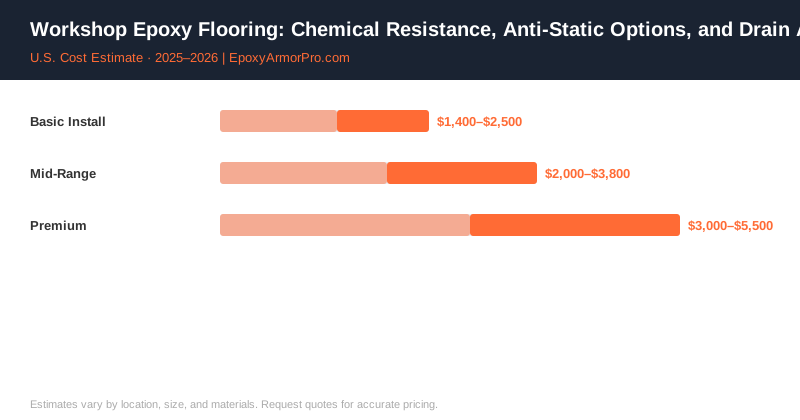
According to the Concrete Network, workshop and garage workshop epoxy averages $3–$7 per square foot professionally installed for a standard system. Your specific needs will push the number within or above that range:
| Workshop Size | Standard System | Cycloaliphatic Upgrade | Novolac System |
|---|---|---|---|
| 400 sq ft (1-car garage workshop) | $1,200–$2,800 | $1,600–$3,600 | $2,200–$4,800 |
| 600 sq ft (2-car garage workshop) | $1,800–$4,200 | $2,400–$5,400 | $3,300–$7,200 |
| 800 sq ft (detached workshop) | $2,400–$5,600 | $3,200–$7,200 | $4,400–$9,600 |
| ESD add-on (per sq ft) | +$2–$4 | — | — |
| Drain detailing (per drain) | $150–$400 | — | — |
If you’re comparing these costs against a DIY epoxy kit, note that consumer-grade kits are virtually never formulated for the chemical resistance a workshop requires. Big-box epoxy kits use water-based or thin solvent-based products that perform well in light-use areas but fail quickly under motor oil and solvent exposure.
Surface Prep in a Working Shop
Workshop floors are often heavily contaminated. Oil, grease, metal filings, sawdust, and years of absorbed chemicals all compete with your coating’s ability to bond to the concrete.
Oil contamination requires specific attention. Grinding over oil-contaminated concrete doesn’t fully remove the oil — it grinds the surface profile while leaving hydrocarbons embedded deeper in the pores. Professional prep for contaminated workshop floors typically involves:
- Hot water pressure washing with degreaser to lift surface contamination
- Diamond grinding to open the surface profile
- Solvent degreasing again after grinding
- Moisture testing (ASTM F1869 or F2170)
- Spot-testing adhesion with a tape pull test
According to the Concrete Network, surface contamination is the leading cause of epoxy delamination in automotive and workshop applications — more common than any product failure. Don’t skip the degreasing steps.
Adding Texture for Workshop Safety
Workshop floors are slip hazards: oil drips, coolant, sawdust, and water all reduce traction. Don’t accept a smooth, glossy finish for a workshop floor.
Standard options:
- Aluminum oxide broadcast: Fine grit added to the topcoat. Most cost-effective, adds $0.50–$0.75 per square foot
- Color flake broadcast: Decorative flakes add both aesthetics and texture, $0.75–$1.50 per square foot
- Shark grip or sand broadcast: Coarser texture for areas with heavy oil or coolant exposure
For automotive bays and machine shops where floors get wet frequently, specify a minimum COF (coefficient of friction) of 0.6 in the wet condition. Ask your contractor for the product’s published COF data — reputable coating manufacturers publish this.
Contractor Referral Disclaimer: EpoxyArmorPro is a contractor referral and cost information service, not a licensed flooring contractor. We connect consumers with independent, licensed, and insured contractors. We do not perform any flooring work directly. Cost estimates are averages based on market data and vary by location, project size, materials, and contractor. Always verify contractor licensing and insurance before hiring. Individual quotes may differ from estimates shown.