Here’s a number that should stop you cold: in Houston, the average relative humidity sits above 80% for more than 200 days per year, according to NOAA climate data. On a concrete slab, that sustained moisture creates a problem that has ruined thousands of epoxy floors — and most homeowners don’t even know it was happening until the coating starts bubbling or lifting months later.
Humidity isn’t just an inconvenience for epoxy installation. It’s an active failure mechanism. If you’re in coastal Florida, the Gulf Coast, New Orleans, Charleston, or Seattle, understanding moisture management isn’t optional — it’s the difference between a floor that lasts 15 years and one that fails in 18 months.
Why Moisture Is Epoxy’s Worst Enemy
Epoxy bonds to concrete through a chemical adhesion process. When moisture is present on the surface — even an invisible film of condensation — it occupies the microscopic surface area the epoxy needs to grip. The epoxy bonds to the water, not the concrete. Then the water evaporates, and the epoxy lifts.
There are actually two separate moisture problems to manage:
Surface moisture: Humidity in the air condenses on cooler concrete surfaces, especially when warm, humid air contacts a slab that’s stayed cooler overnight. This is the same physics that fogs your glasses when you walk from an air-conditioned building into summer air. You may not be able to see this moisture film — but it’s there.
Moisture vapor transmission (MVT): This is water vapor moving upward through the concrete slab from the soil beneath it. All concrete is somewhat porous, and slabs near the water table — common in Florida, coastal Louisiana, and lowland Pacific Northwest areas — can push substantial vapor upward, especially in warm months. The American Concrete Institute (ACI) recommends that MVT rates exceed no more than 3 pounds of moisture per 1,000 square feet per 24 hours for standard epoxy application. Many coastal slabs fail this test.
The Dehumidifier Requirement
Serious epoxy contractors in Florida and the Gulf Coast routinely run industrial dehumidifiers in the garage for 24–48 hours before and during installation. This isn’t optional in peak summer months — it’s standard practice.
The target: get the relative humidity in the work space below 85%, and ensure the concrete surface temperature is at least 5°F above the dew point. That 5°F buffer prevents condensation from forming on the slab as ambient conditions fluctuate. Many contractors use a combination: dehumidifier to drop overall RH, plus fans to keep air moving across the slab surface.
On very humid days, some contractors will also use a propane or electric heater to warm the concrete slightly above ambient air temperature. A warmer substrate doesn’t condense moisture from air that’s cooler — it stays dry. This is a technique borrowed from marine coating applications, and it works.
| Pre-Application Step | Purpose | Required In |
|---|---|---|
| Industrial dehumidifier (24–48 hrs) | Lower ambient RH below 85% | FL, Gulf Coast, PNW summer |
| Dew point check (infrared + hygrometer) | Confirm 5°F surface-to-dew-point gap | All high-humidity climates |
| Calcium chloride moisture vapor test | Measure MVT rate through slab | Coastal FL, Louisiana, low-elevation PNW |
| Concrete drying/heating | Warm slab above dew point | Gulf Coast summer installs |
| Moisture-tolerant primer | Bridge minor MVT through slab | When MVT is elevated but manageable |
Regional Breakdown: What to Expect
Florida
Florida slabs are often poured on or near the water table. South Florida is particularly challenging — in Miami-Dade and Broward counties, groundwater can sit within a few feet of the surface. The MVT rates in these slabs can be high enough to require a specialized moisture-mitigation epoxy primer before any decorative coating goes down.
Good news: Florida winters (December–February) are legitimately excellent for epoxy installation. Substrate temps in the 65–75°F range, RH typically in the 50–65% range — conditions that rival the best spring days in the Midwest. If you’re in Florida and have flexibility, scheduling in winter avoids the worst humidity complications entirely.
Gulf Coast (Houston, New Orleans, Mobile, Biloxi)
Houston is one of the hardest markets for epoxy installation in the US. You’ve got summer heat, brutal humidity, and clay soils that hold moisture. A contractor who hasn’t done Gulf Coast work may not even know to test for MVT — they’ll just coat, and it’ll fail. Ask specifically about their moisture testing protocol before hiring anyone.
New Orleans has similar challenges, compounded by the city’s elevation below sea level in many areas. MVT is essentially guaranteed in many NO garages.
Pacific Northwest (Seattle, Portland, Tacoma)
The Pacific Northwest has a different humidity profile than the Gulf Coast — it’s cooler and persistently damp rather than hot and humid. Seattle averages 150+ days per year with precipitation, and garages in the region frequently have concrete that’s chronically damp from ground moisture and lack of sunlight.
The good news: PNW summers (July–September) are actually excellent for epoxy. Dry, mild, low humidity — some of the best install conditions in the country. Spring and fall installs require careful moisture management, and winter installs are genuinely risky without a heated, dehumidified space.
- Test concrete moisture with a plastic sheet test or professional calcium chloride test
- Run dehumidifier for 24–48 hours before application, target RH below 85%
- Confirm surface temp is at least 5°F above dew point with an infrared thermometer + hygrometer
- Ask your contractor if they’ll use a moisture-tolerant primer (critical for high-MVT slabs)
- Schedule in the dry season when possible (Florida winter, PNW summer)
Moisture-Tolerant Products for High-Humidity Installs
Not all epoxy primers are created equal for humid conditions. Water-based epoxy primers — the type in most big-box DIY kits — are essentially incompatible with high-MVT slabs. They’re designed for dry, controlled conditions.
Professional contractors in high-humidity climates use:
Moisture-tolerant (MT) epoxy primers: These are 100% solids or solvent-based formulations that can be applied to damp (but not wet) concrete and maintain adequate adhesion despite modest MVT. They’re not magic — they can’t overcome 10 lbs/1,000 sq ft/24 hr MVT — but they bridge the gap for typical coastal slab conditions.
Epoxy moisture mitigation systems: For severe cases, a dedicated vapor barrier membrane goes down before any decorative coating. These systems are common in commercial flooring and increasingly used in high-end residential installs in South Florida and coastal Louisiana. They add cost ($1–$3/sq ft) but effectively decouple the decorative coating from whatever the slab is doing moisture-wise.
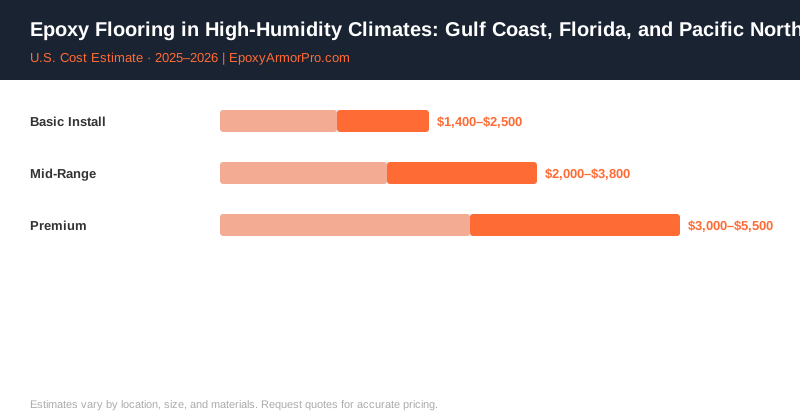
What to Budget for High-Humidity Installs
Moisture management adds time and materials cost to any install in these climates.
| Cost Component | Typical Range |
|---|---|
| Standard 2-car garage epoxy (national avg) | $1,200–$2,400 |
| Moisture-tolerant primer upgrade | +$150–$350 |
| Moisture mitigation membrane (severe cases) | +$400–$1,200 |
| Professional MVT testing (calcium chloride) | $75–$200 |
| Dehumidifier rental (if homeowner-supplied) | $50–$100/day |
For total cost context, see our garage epoxy flooring guide.
One Final Warning
If a contractor gives you a quote for a Gulf Coast or South Florida garage without mentioning moisture testing at all, that’s a red flag. It doesn’t mean they’re incompetent — but it probably means they’re not accounting for the real work involved. A low quote that skips moisture management is a floor that’ll need replacing in 2 years. It’s not a bargain.
Contractor Referral Disclaimer: EpoxyArmorPro is a contractor referral and cost information service, not a licensed flooring contractor. We connect consumers with independent, licensed, and insured contractors. We do not perform any flooring work directly. Cost estimates are averages based on market data and vary by location, project size, materials, and contractor. Always verify contractor licensing and insurance before hiring. Individual quotes may differ from estimates shown.