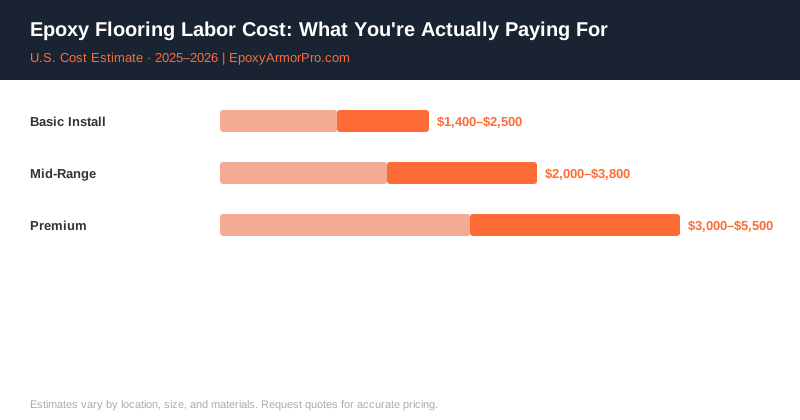
$1,200 for a two-car garage floor. That’s a real quote — and it’s reasonable. So is $2,400 for the same 480-square-foot space. The difference between those two numbers is almost entirely labor, and understanding what labor actually buys you is the key to knowing which quote to trust.
Here’s the honest breakdown of where that money goes and how to tell a fair rate from a padded one.
What Labor Includes on an Epoxy Job
Labor on an epoxy floor installation isn’t just rolling product onto concrete. A properly done job involves a sequence of distinct tasks, each with real time requirements:
1. Surface Preparation (40–60% of total labor time)
Diamond grinding is the foundation of any quality installation. A professional installer runs a walk-behind or hand grinder over the entire floor to open the concrete’s pores, remove surface contaminants, and create the mechanical profile that epoxy needs to bond. On a 480-square-foot garage, grinding takes 2–5 hours depending on floor condition.
This is the step that separates a floor that lasts 15 years from one that delaminate in two. According to the International Concrete Repair Institute (ICRI), proper mechanical surface preparation is the single most critical factor in coating adhesion.
2. Crack and Joint Repair
After grinding, all cracks, spalls, and control joint failures get filled with polyurea or polyurethane filler. Minor hairline cracks take 30–60 minutes total. Floors with settlement cracking or significant spalling can add 2–4 hours to the job.
3. Moisture Testing
Professional installers check moisture vapor emission rate (MVER) before coating. Applying epoxy over concrete with high moisture drives coating failure. This step takes 15–30 minutes per test point.
4. Primer Application
A penetrating epoxy primer goes down first, cut into edges and rolled across the field. Cure time (not labor time) adds 4–8 hours between primer and base coat. Active labor: 45–90 minutes.
5. Base Coat and Flake Broadcast
The main color coat goes down, immediately followed by broadcast vinyl flakes if you’re doing a chip system. This step requires two workers — one rolling, one broadcasting. Active labor: 1–2 hours.
6. Topcoat Sealer
The final clear polyaspartic or urethane topcoat locks in the flakes and provides the wear surface. Active labor: 45–90 minutes.
Total active labor for a standard two-car garage: 8–14 hours, usually spread across two days to allow cure time between coats.
Labor Rates by Region
Contractor labor rates vary meaningfully by market. According to Angi’s 2024 cost data, national averages run:
| Region | Labor Rate Range | 480 Sq Ft Labor Cost |
|---|---|---|
| Northeast (NYC, Boston) | $3.50–$6.00/sq ft | $1,680–$2,880 |
| West Coast (LA, Seattle) | $3.00–$5.50/sq ft | $1,440–$2,640 |
| Midwest (Chicago, Columbus) | $2.00–$3.50/sq ft | $960–$1,680 |
| Southeast (Atlanta, Tampa) | $1.75–$3.00/sq ft | $840–$1,440 |
| Southwest (Dallas, Phoenix) | $1.75–$3.00/sq ft | $840–$1,440 |
| National Average | $2.00–$4.00/sq ft | $960–$1,920 |
These are labor-only figures. Materials add $1.00–$3.00/sq ft on top, depending on the system.
Breaking Down a Typical Quote
When you get a contractor quote, it usually won’t be itemized by task. But you can back-calculate what’s reasonable. A fair two-person crew on a 480-square-foot garage should earn $800–$1,400 in labor over two days at competitive rates. Here’s how to sense-check any quote:
| Labor Task | Estimated Hours | % of Total Labor |
|---|---|---|
| Diamond grinding | 3–5 hrs | 35–45% |
| Crack repair & moisture testing | 1–2 hrs | 10–15% |
| Primer application | 1 hr | 8–10% |
| Base coat + flake broadcast | 2–3 hrs | 18–25% |
| Topcoat application | 1–2 hrs | 10–15% |
| Setup, cleanup, edgework | 1–2 hrs | 8–12% |
What “Low Labor Cost” Actually Means
A quote at $1.00–$1.50/sq ft for professional labor isn’t a deal — it’s a warning. At those rates, contractors are either:
- Skipping diamond grinding and using acid etching instead (far less effective for bond strength)
- Using a single-coat system with minimum product, no primer, no topcoat
- Rushing cure times between coats, which compromises the chemical bond
- Cutting crew size so one person is trying to roll and broadcast flakes simultaneously (impossible to do well)
The math doesn’t lie: if a two-person crew charges $800 for a full day’s work on your garage, that’s $50/hour total — before equipment costs, fuel, and materials. Nobody does quality work at those margins.
When Higher Labor Costs Are Justified
Some situations genuinely require more labor and the higher price is legitimate:
Heavily damaged floors. Spalling, deep cracks, and previous coating removal can double prep time and add $300–$800 to the job. Before coating any damaged floor, fix the cracks properly.
Moisture barrier requirements. Concrete with high MVER needs a moisture-mitigating primer as an additional coat. That’s $0.50–$1.00/sq ft in materials and another pass of labor.
Tight access or obstacles. Basement stairs, built-in cabinets, pillars, and floor drains all slow down grinding and rolling. Expect 15–25% higher labor costs in complex spaces.
Multi-room projects. Moving equipment between a garage, laundry room, and basement takes time. A whole-house epoxy project commands different labor economics than a single garage floor.
Getting the Most From Your Labor Dollar
The best leverage you have on labor cost is floor condition before the crew arrives. An unobstructed floor with no obstacles saves the crew setup and cleanup time, which is pure margin they can pass to you.
Clearing your garage completely — removing bikes, toolboxes, shelving units — is worth negotiating on. Some contractors will reduce the quote by $100–$200 if the floor is completely cleared and clean when they arrive. Ask directly. Many won’t volunteer it.
For a complete picture of total project costs, see epoxy flooring cost per square foot and the DIY vs. professional comparison.
Contractor Referral Disclaimer: EpoxyArmorPro is a contractor referral and cost information service, not a licensed flooring contractor. We connect consumers with independent, licensed, and insured contractors. We do not perform any flooring work directly. Cost estimates are averages based on market data and vary by location, project size, materials, and contractor. Always verify contractor licensing and insurance before hiring. Individual quotes may differ from estimates shown.