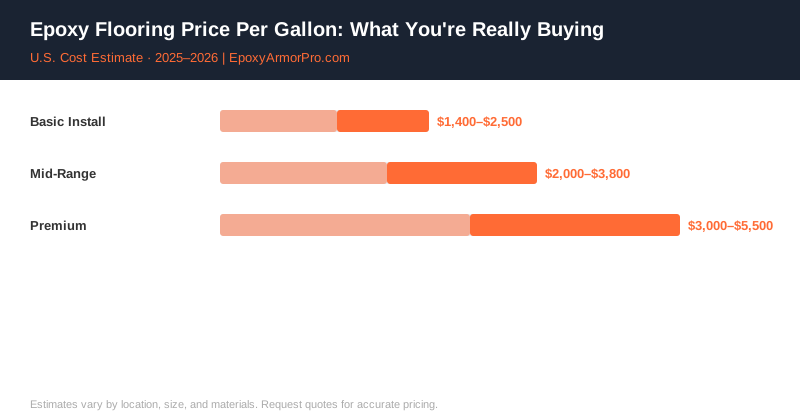
Here’s something that’ll surprise you: the cheapest epoxy per gallon often costs more per square foot than professional-grade products. A $45 big-box epoxy kit that covers 500 square feet sounds like a bargain. A $160/gallon professional epoxy that covers only 150 square feet sounds expensive. But the professional product leaves 3× more actual coating on your floor — and lasts 4× longer. The gallon price is almost irrelevant. What matters is solids content and real coverage.
Let’s break down what you’re actually buying at each price point.
The Epoxy Product Landscape
Walk into a Home Depot, browse an industrial supply catalog, or call a contractor, and you’ll encounter four fundamentally different product categories all sold as “epoxy”:
1-part epoxy paint — not real epoxy. It’s latex or alkyd paint with a small percentage of epoxy resin added for marketing purposes. No real chemical cure occurs.
Water-based 2-part epoxy — a true two-component system that cures through chemical reaction, but diluted with water as the carrier. Lower VOC but also lower solids content.
Solvent-based 2-part epoxy — stronger bond than water-based, higher solids content, but higher VOC and more sensitive application requirements.
100% solids epoxy — no carrier solvent or water. Every molecule of material stays on the floor. Thickest build, longest life, and what professional contractors typically use.
Price Per Gallon by Product Type
| Product Type | Price Per Gallon | Solids Content | Coverage Per Gallon | True Cost Per Sq Ft |
|---|---|---|---|---|
| 1-part epoxy paint (big-box) | $30–$50 | 30–45% | 300–400 sq ft | $0.10–$0.17 |
| Water-based 2-part (DIY kit) | $50–$90 | 45–60% | 200–300 sq ft | $0.23–$0.35 |
| Solvent-based 2-part | $80–$130 | 65–80% | 150–200 sq ft | $0.50–$0.75 |
| 100% solids (professional) | $120–$180 | 100% | 100–150 sq ft | $1.00–$1.50 |
| Metallic/decorative 100% solids | $180–$250 | 100% | 80–120 sq ft | $1.75–$2.50 |
| Polyaspartic topcoat | $100–$160 | 85–100% | 150–200 sq ft | $0.65–$1.00 |
Notice what happens to the “true cost per square foot” column. The $45 big-box paint looks like $0.12/sq ft. But that’s for one coat at 300 sq ft/gallon. You’ll need two coats minimum, bringing it to $0.24/sq ft — and you’re getting roughly 4–6 mils of dry film thickness. The $150/gallon professional 100% solids applied at one coat delivers 16–20 mils. Four times the actual coating for about six times the material cost per gallon. That’s not a rip-off. That’s physics.
Why Cheap Gallon Prices Are Deceptive
The number printed on the label is theoretical coverage — applied at 10 mils wet on a perfectly smooth surface. Reality subtracts from that number in three ways:
Surface porosity. Fresh or rough concrete absorbs product. A porous slab can consume 20–30% more material than the label estimate, especially on the first coat.
Multiple coats. Any real system uses 2–3 coats. The label coverage is per coat. A three-coat system at 300 sq ft/gallon needs 3× the gallons.
Waste. Mixing ratios matter. If you mix more than you can apply before pot life expires (the working time before the epoxy sets up in the bucket), you throw away the excess. Cheap big-box kits with 20-minute pot life waste 15–25% on large floors.
Real cost per sq ft = (price per gallon ÷ actual coverage per gallon) × number of coats
Example: $150/gallon product at 120 sq ft/gallon, 3 coats = ($150 ÷ 120) × 3 = $3.75/sq ft material cost alone. Then add labor, prep, and topcoat.
For a full cost per square foot breakdown, that formula is your starting point.
Brand Tiers and What They Mean
Consumer/Retail Tier ($30–$90/gallon)
Brands like Rust-Oleum EpoxyShield, Quikrete Epoxy, and similar big-box products. Mostly 2-part water-based formulas with 45–60% solids. Designed for DIY application with minimal prep. Fine for light foot traffic in a clean utility space. Not designed for vehicle traffic or serious chemical exposure.
Expected life with proper prep: 2–5 years before chipping and peeling begin.
Professional-Grade ($100–$180/gallon)
Brands like Sherwin-Williams ArmorSeal, Rust-Oleum Professional, Simiron, and contractor-supply products. 85–100% solids, designed for mechanical surface prep (grinding), multiple-coat systems. What most residential contractors use.
Expected life: 10–20 years when properly installed.
Specialty/Decorative ($150–$250/gallon)
Metallic epoxy systems (Pearl, Liquid Metallic), quartz broadcast systems, and broadcast chip systems with premium polyaspartic topcoats. These aren’t more durable than standard professional-grade — they’re more decorative. You’re paying for appearance and special effects, not longer life.
Expected life: 10–20 years (same as standard professional grade).
How Much Product Does a Two-Car Garage Actually Need?
Working through a real example: 480-square-foot garage, 3-coat system (primer + base + topcoat), professional-grade materials.
| Coat | Product | Coverage | Gallons Needed | Cost |
|---|---|---|---|---|
| Primer | 100% solids epoxy primer | 200 sq ft/gal | 2.5 gallons | $200–$350 |
| Base coat | 100% solids epoxy | 150 sq ft/gal | 3.2 gallons | $400–$550 |
| Topcoat | Polyaspartic | 175 sq ft/gal | 2.75 gallons | $300–$450 |
| Total materials | ~8.5 gallons | $900–$1,350 |
Add 15% waste factor: roughly 10 gallons total, $1,035–$1,550 in materials for a properly done professional system. That material cost alone exceeds the total quote from many low-end contractors — which should tell you exactly what those low-end contractors are installing.
DIY Material Buying Tips
If you’re doing a DIY installation, a few things make the gallon price less relevant:
Buy from contractor suppliers, not big-box. Even for DIY projects, purchasing from a Sherwin-Williams Pro or industrial distributor gets you higher-solids products at roughly the same price as big-box kits. You’ll get twice the coating for the same money.
Don’t buy more than you need. Mixed epoxy has a limited pot life. Buying slightly less than you think you need and doing a second trip is better than mixing excess that hardens in the bucket.
Match the hardener ratio exactly. Two-part epoxies fail when the resin-to-hardener ratio is off. Don’t estimate — measure by weight or volume exactly as specified.
For a budget-friendly approach to quality results, the cheap floor coating guide covers where you can and can’t cut corners on materials.
Contractor Referral Disclaimer: EpoxyArmorPro is a contractor referral and cost information service, not a licensed flooring contractor. We connect consumers with independent, licensed, and insured contractors. We do not perform any flooring work directly. Cost estimates are averages based on market data and vary by location, project size, materials, and contractor. Always verify contractor licensing and insurance before hiring. Individual quotes may differ from estimates shown.