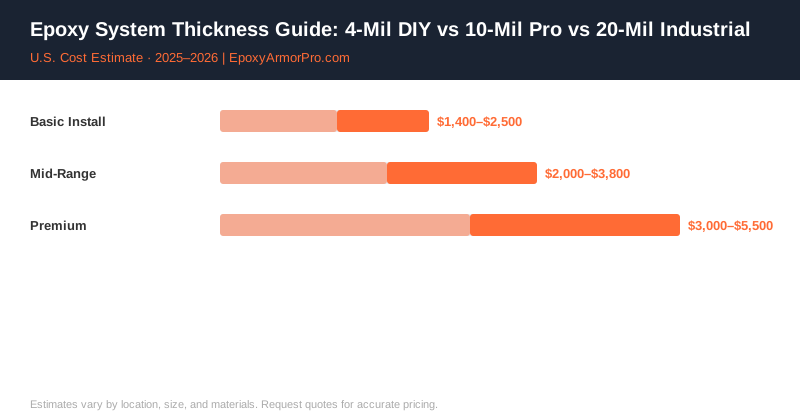
Most hardware store epoxy kits don’t tell you how thick the finished film actually is. That’s not accidental. If the number were on the front of the can — “applies at 4 mils dry film thickness” — far fewer homeowners would buy it thinking it was comparable to what a contractor installs.
Film thickness is the single most important variable in how long any floor coating lasts. Here’s what the numbers mean and which one you actually need.
How Film Thickness Is Measured
Floor coating thickness is measured in mils — thousandths of an inch. One mil is 0.001 inch. For reference, a standard sheet of copy paper is about 4 mils thick.
There are two relevant measurements:
Wet film thickness (WFT): How thick the coating is immediately after application before solvents evaporate and curing occurs. This is what applicators measure with a wet film gauge during installation.
Dry film thickness (DFT): How thick the coating is after full cure. This is what matters for durability. DFT is always less than WFT because solvents evaporate during curing.
The ratio of DFT to WFT is called the “volume solids” percentage. A 50% solids product loses half its thickness during cure. A 100% solids product (no solvents) loses virtually nothing — what you apply is what you get.
This is why “100% solids” epoxy, used by professional contractors, produces much thicker finished films from the same wet application thickness compared to DIY kits with 40–60% solids content.
The Three Tiers of Epoxy System Thickness
4-Mil: DIY Box Store Kit
A standard one-car garage epoxy kit from the hardware store applies at approximately 4–6 mils DFT total for the complete system (primer + color coat + topcoat). Some premium DIY kits advertise up to 8 mils, but achieving that in practice requires applying the full kit to a smaller area than the label coverage rate suggests.
According to the Concrete Coating Association, 4-mil systems are suitable for light foot traffic in residential interiors but are not recommended for vehicle traffic areas where point loads and thermal stress from hot tires are present.
4-mil systems are appropriate for:
- Basement floors with foot traffic only
- Laundry rooms and utility areas
- Storage spaces where no vehicles enter
4-mil systems are not appropriate for:
- Any garage with vehicle use
- Spaces with heavy point loads (toolboxes, shop equipment)
- Climates with significant temperature swings (freeze-thaw, hot summers)
10-Mil: Professional Residential Standard
A professionally installed epoxy system for a residential garage typically lands at 10–16 mils DFT total — usually composed of a moisture-tolerant primer (2–4 mils), pigmented base coat with decorative flake (4–8 mils), and clear polyaspartic or urethane topcoat (2–4 mils).
This thickness range is what the garage epoxy flooring guides refer to when recommending professional installation. At 10–16 mils, the system:
- Resists hot tire pickup (the single most common residential failure mode)
- Handles foot traffic from cleated boots, rolling toolboxes, and shop equipment
- Provides chemical resistance to automotive fluids
- Lasts 10–20 years with normal maintenance
The additional thickness relative to DIY kits isn’t just about durability — it’s about bridging minor surface irregularities, hairline cracks, and texture variations in the concrete without creating stress points.
20-Mil: Commercial and Industrial
Industrial epoxy floors — warehouses, food processing plants, commercial kitchens, manufacturing floors — are commonly specified at 20–40 mils DFT. Some heavy-duty industrial systems exceed 100 mils (1/10 inch) for extreme chemical exposure or heavy forklift traffic.
The Occupational Safety and Health Administration (OSHA) and various industry standards bodies specify minimum floor coating thickness requirements for different industrial environments. Pharmaceutical cleanrooms, for example, often require 30+ mil seamless systems to prevent bacterial harborage.
For commercial epoxy flooring in restaurants, retail, and light manufacturing, 20 mils is a common starting spec.
| System | DFT Range | Typical Application | Cost per Sq Ft (installed) |
|---|---|---|---|
| DIY kit (box store) | 4–8 mils | Basement, storage, light residential | $0.50–$1.50 materials only |
| Professional residential | 10–16 mils | Garage, workshop, residential | $3–$7/sq ft |
| Commercial/light industrial | 16–25 mils | Restaurant, retail, light warehouse | $5–$10/sq ft |
| Heavy industrial | 25–100+ mils | Food processing, pharma, heavy forklift | $8–$20+/sq ft |
What Thickness You Actually Need by Use Case
Residential garage (vehicle storage, hobby work): 10–14 mils. Professional residential system with 100% solids epoxy base and polyaspartic topcoat.
Residential workshop (power tools, heavy equipment): 12–18 mils. Add a build coat or specify a higher-mil base layer than standard residential.
Home gym or basement: 6–10 mils. A quality DIY kit or light professional system is sufficient. No vehicle loads, no hot tire stress.
Restaurant or commercial kitchen: 20–30 mils minimum. Chemical resistance and anti-slip (quartz broadcast) are priorities alongside thickness.
Light warehouse or retail: 16–24 mils. Pallet jack and light forklift traffic requires meaningful thickness and hardness.
Heavy manufacturing or food processing: Spec with a coatings engineer. These applications go beyond standard epoxy into specialized systems.
Why “Thicker” Isn’t Always the Answer
More mils aren’t automatically better. Excessively thick coatings on concrete slabs with high moisture vapor transmission can trap vapor and cause delamination under hydrostatic pressure. The system needs to be matched to the substrate condition, not just the traffic load.
For residential garage slabs with known moisture issues, a moisture-tolerant primer specified at the correct thickness matters more than adding extra topcoat mils. Adding thick build coats over an inadequate primer just means the delamination happens further up the system.
The right approach: test for moisture vapor emission rate (MVER) before specifying system thickness, and select a primer that accommodates the slab’s actual moisture level.
The Cost-Per-Mil Math
Here’s the framing that makes the value case clearest:
| System | Installed Cost (500 sq ft garage) | DFT | Cost per Mil per Sq Ft |
|---|---|---|---|
| DIY kit (materials only) | $250–$500 | 5 mils avg | $0.10–$0.20/mil |
| Professional residential | $1,500–$3,500 | 12 mils avg | $0.25–$0.58/mil |
| Commercial system | $2,500–$5,000 | 20 mils avg | $0.25–$0.50/mil |
On a per-mil basis, professional systems aren’t dramatically more expensive than DIY kits — they’re just delivering significantly more thickness, better-quality materials, and professional labor. The $3,000 professional job versus the $350 DIY kit isn’t 8.5× the cost for the same thing. It’s a 12-mil film of 100% solids material versus a 5-mil film of 50% solids material, installed by someone who prepared the surface correctly.
Contractor Referral Disclaimer: EpoxyArmorPro is a contractor referral and cost information service, not a licensed flooring contractor. We connect consumers with independent, licensed, and insured contractors. We do not perform any flooring work directly. Cost estimates are averages based on market data and vary by location, project size, materials, and contractor. Always verify contractor licensing and insurance before hiring. Individual quotes may differ from estimates shown.